

The Consumer Evolution
A new model offers a dynamic framework for understanding fast-changing consumer needs

One of the things I’ve been amazed at since I was “done done” with The Transformation Economy last fall is how many new ideas, principles, and even frameworks I’ve thought of since then. (Well, one new framework anyway….)
With The Experience Economy, it felt like I just coasted on what we wrote for a few years before the new ideas started kicking in. That’s probably an exaggeration, but it’s what it felt like.
This post-book period feels completely different
Now, it feels completely different. Partly that’s because I spent a lot of time writing The Transformation Toolkit as a companion to the book, which not only involved writing 18,000+ new words on the topic, but developing new thinking on how to use the concepts in the book.
But mostly I think it’s because of you, my Substack subscribers! I made a commitment to keep writing here and share – along with articles, book reviews, events, and news items –new discoveries, such as my two-part series on Sales Calls a Invitational Transformations and last week’s post on From Third Place to Transformation Chrysalis. [By the way, I keep adding links to even recent posts because every week over the past year I’ve added an average of about 16 new subscribers.]
Now here’s a new set of ideas on consumer evolution
Given that, this week’s post is not about a new discovery, but rather a set of ideas I’ve been working on for several years – coincident with writing the book! – with my colleague Marco Robledo, professor of management, University of the Balearic Islands, and author of 3D Management, an Integral Theory for Organisations in the Vanguard of Evolution. (And one day, Marco, I hope we can meet F2F!)
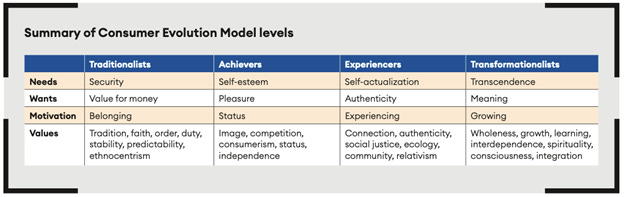
As his book above attests, Marco is an expert on what’s called “integral theory”, developed by philosopher Ken Wilber, that integrates many different philosophies through a framework that simultaneously examines the four dimensions of mindset, behavior, culture, and systems. Marco applied this theory to consumers, and noticed a high degree of commonality between how people progress through stages and the Progression of Economic Value, and so in our collaboration we developed this Consumer Evolution Model:
Our full article on this, “The Consumer Evolution”, was just published in Duke Corporate Education’s Dialogue Review.
In it you’ll see that after describing the four different stages of consumers –traditional, achieving, experiential, and transformational – we discuss how
The Consumer Evolution Model is a strategic compass, guiding companies toward customer-centric strategies. It is descriptive, offering myriad approaches – whether focusing on a single stage or adopting a multilevel approach. Timex is focused on Traditionalists, LVMH on Achievers, Meow Wolf on Experiencers, and many travel companies on Transformationalists – while the multilevel approach is exemplified by Marriott with its diverse brand portfolio.
And then describe four strategic shifts companies can embrace:
1. From a fixed mindset to an evolutionary mindset
2. From segments and personas to individual journeys
3. From suppliers to guides in personal growth
4. From goods and services to experiences and transformations
using examples such as Mattel, Patagonia, and Eataly.
I trust you will gain value from the full article (which does not require a subscription). Enjoy!
Joe
© 2026 B. Joseph Pine II