

Sales Calls as Invitational Transformations, Part Two
And how much value they can create for you


In Part One of this post I wrote about how even sales calls could become transformations, invitational transformations in particular. Here I’ll go deeper – much deeper, as you will see – to show you where and when you can create marketing experiences & invitational transformations.
The Placemaking Portfolio
In particular, you can apply the Placemaking Portfolio to your business to see where and when you can create invitational transformations:
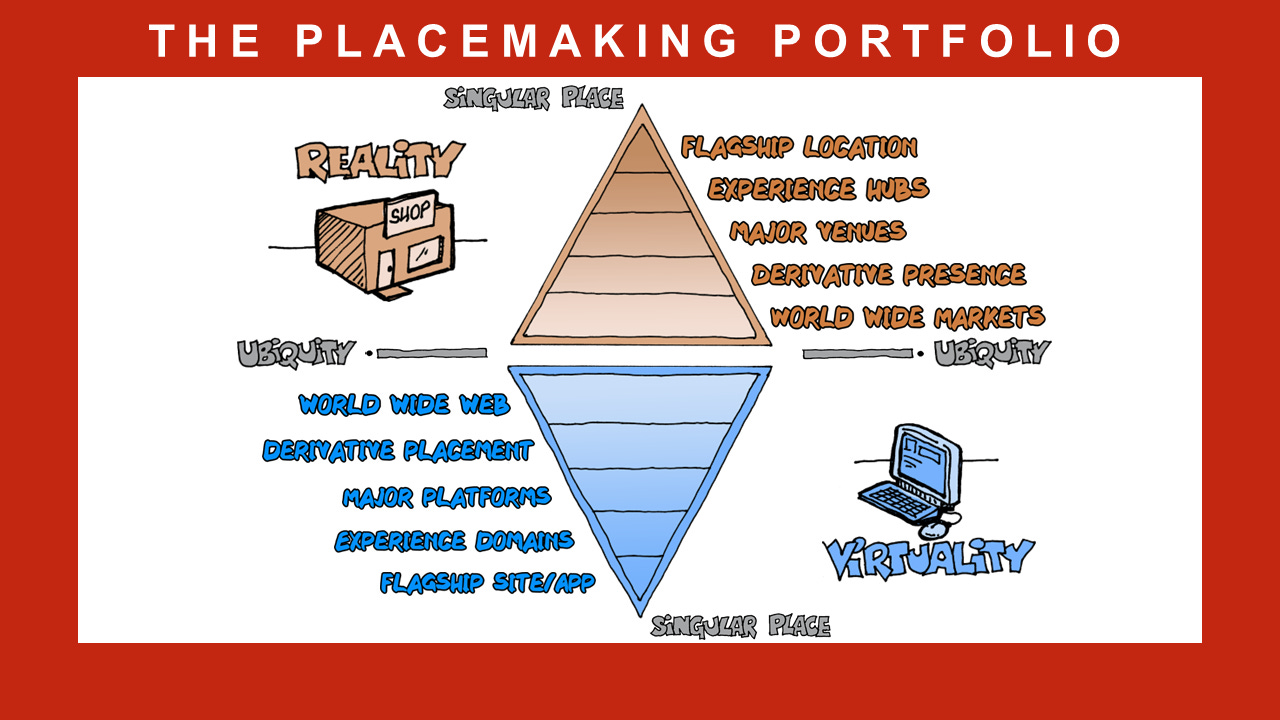
Originally called the Location Hierarchy Model, Jim Gilmore and I renamed it in our book Authenticity: What Consumers Really Want to more align with our thinking that authenticity was the new consumer sensibility that arose due to the shift into the Experience Economy. (What is the new consumer sensibility for the shift into the Transformation Economy? I think I know, but it’s too early to tell for sure.) We dubbed marketing experiences “placemaking experiences” to make the point that in order to be what they say they are (one of the two key standards of authenticity) companies need to create experience places where current and potential customers can experience who they are.
Create experience places where current and potential customers can experience who you are
From the figure you can see that this diamond-shaped model has two mirrored halves in Reality and Virtuality, each with five levels. The width of each level indicates the relative number of physical or virtual places that can be created, ranging from the flagships at the ends – what should be the singular, best, and most immersive experiences – to reaching toward ubiquity in the middle.
The examples I mentioned above in Part One of this post – the Abraham Lincoln Presidential Library & Museum and the Johnnie Walker Princes Street experience – both operate at the Flagship Location level, where you create the biggest and best experiences. While the Lincoln place is the only one run by the non-profit Abraham Lincoln Presidential Foundation (with the state of Illinois), Johnnie Walker has many other such marketing-experiences-cum-invitational-transformations, including Johnnie Walker Houses in Shanghai, Singapore, and other Experience Hubs, four visitor centers spread out across Major Venues in Scotland, and retail spaces in the Derivative Presence of international airports. The brand reaches World Wide Markets through every retail store it is in but doesn’t itself create any experiences there. Although it is possible that every day someone who’s never had a whiskey before (Scotch or otherwise) picks up a bottle of Johnnie Walker and thereby becomes a convert to whiskey-drinking and to the brand.
Creating digital experiences are much cheaper and easier to do, but less effective
Creating digital experiences on the Virtuality half of the Placemaking Portfolio are much cheaper and easier to do, but they rarely offer the level of immersion, engagement, and purchasing encouragement that the Reality half does. It can be done; LEGO System A/S, for example, has marketing experiences at every level physical and virtual, where again every day people newly identify themselves with LEGO bricks, LEGO playing, and the LEGO brand.
Avon’s social selling increasingly relies on digital tools and experiences as well. Ambassadors of course use all manner of social media to reach current and potential customers, but also get their own personalized Digital Catalog, which can then be further customized to each customer so they see the products they’ve purchased in the past and are most likely to be interested in now. Avon further created a virtual try-on tool (something pioneered by L’Oreal) so people can see how they look with various products and shades.
Use the Placemaking Portfolio for ideation to develop many possibilities for where and when you can create invitational transformations
This is just a sketch of the Placemaking Portfolio, but if you want to create invitational transformations (or even only marketing experiences) I highly recommend you use it for ideation to develop many possibilities for where and when you can create them. If you find the idea intriguing and want to learn more, the best resource is Chapter 8, “From Marketing to Placemaking”, in Authenticity: What Consumers Really Want. (For those more academically inclined with access to ResearchGate, you can also read an article here.)
Proving the Efficacy of Invitational Transformations
In that chapter (although not in the article) we contrast the efficacy of marketing experiences with traditional advertising campaigns. You can see that here, where the efficacy of advertising is measured by the number of people the campaign reaches times their recall rate, divided by the cost:
