

From Third Place to Transformation Chrysalis
An intriguing new idea


Last month I did a speech and two workshops at the Third Place Summit in Rotterdam, the Netherlands.
I was invited to do so by Aat Vos, the founder of the architecture and design firm includi, which focuses on creating third places, especially libraries. Aat and his team kindly featured me and my work in his book 3rd4all: How to Create a Relevant Public Space (and if you take a look at that link, you’ll see it takes a team to design a book like that!). He and colleague Amy Goedhart, an urban anthropologist, also just recently published Come Stay Grow, three imperatives that formed the structure of the event, with me speaking on Grow and then facilitating workshops, including one on determining your own Progression of Economic Value (based on the first tool in The Transformation Toolkit).
Third Places
If you’re not familiar with the concept, third places are venues that people frequent outside of home (first place) and work (second place). The term was coined by sociologist Ray Oldenburg in 1989 in his (newly updated and highly recommended) book The Great Good Place: Cafes, Coffee Shops, Bookstores, Bars, Hair Salons, and Other Hangouts at the Heart of a Community. I’ve always loved the concept, for third places are liminal places and times, betwixt and between home and work, and therefore possess great possibilities for not only gaining a respite from the too-often harried world, but for thinking, socializing, and imagining.
Third places are liminal places and times, betwixt and between home and work
My speech started with a discussion of the Experience Economy focused on the four realms of experience: entertainment, educational, escapist, and esthetic. I made the point that third places lie largely within that fourth realm, esthetic, for they provide an experience in which people want to come in, sit down, hang out, and just be. (That’s a formulation Jim Gilmore and I developed decades ago!)
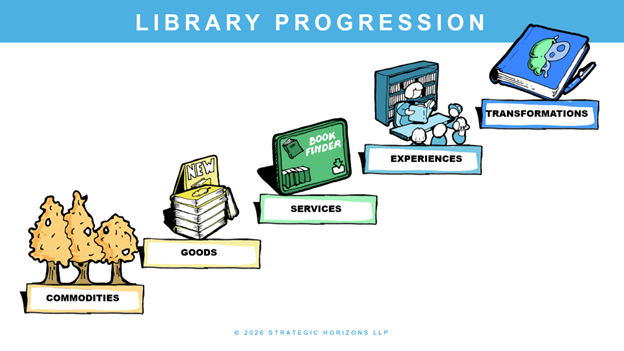
Then I segued into the Transformation Economy with a number of examples, including a custom Progression of Economic Value just for libraries, which represented a significant portion of the audience, as illustrated by Kevin Dulle:
I then went through what has become a favorite story of mine for companies that know they’re in the experience business, here taken from chapter 6 (p. 143) of The Transformation Economy:
I once spoke to the annual conference of the American Alliance of Museums, largely consisting of curators and managers. I asked the hundreds of attendees to raise their hands if they worked in the museum world today because of an experience they had in a museum when they were young. About 40% raised their hands! I’ve often used this anecdote when working with clients in all manner of immersive experiences, themed attractions, and the like to assert that they, too, have sparked many kids and not a few adults to join art, attractions, and other experience businesses as artists, designers, and creators. Not to mention those who acquired lifelong avocations for gardening, history, science, and so many other subjects because of related experiences as a kid or adult.
And so, do libraries and other third places spark life-transforming experiences for people.
Transformation Chrysalises
This is where I then brought in the idea that third places should think of themselves as transformation chrysalises, illustrating it with this Third Place Progression:
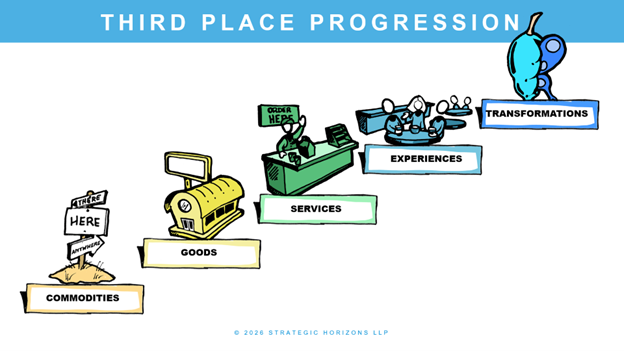
Like a third place, a chrysalis is a liminal place and time, betwixt and between what was before and what will be. Literally in the case of a caterpillar transforming into a butterfly, and metamorphically for anyone going through a transformation. I urged the audience to recognize the opportunity – and the great contribution to human flourishing it would be! – of considering themselves as chrysalises for transformations, guiding their customers in achieving their aspirations. The best way of doing so, I said, was to encapsulate their third place experiences with preparation beforehand, reflection afterward, and integration on an ongoing basis. (While I will continue to provide relevant links to Substack posts, I will also offer pages in the book to read, here being pp. 92-97.)
A chrysalis is a liminal place and time, betwixt and between what was before and what will be
I closed by harkening back to my discussion of the esthetic realm of experience, ending my speech with these words: Don’t solely be a place where people come in, sit down, hang out, and just be, but one where they can become. (If I had a handheld mic, I would have dropped it. . . .)
How to Use Encapsulation
Now, I did not think richly about how third places would go about this, but then a realization occurred to me while facilitating a workshop.
Being liminal, third places offer the perfect places for reflection and preparation
Most everyone who spends time in a third place is already going through one or more transformation journeys! Third places don’t need to instigate them, or have encapsulated experience after encapsulated experience to guide aspirants. No, being liminal they offer the perfect places for reflecting on the most recent transformative experiences some other company was guiding, then preparing them for the next experience, which means they can really be in the business of integrating the journeys its customers were already on! Particularly because people come there again and again, and the human connections created between staff and customers naturally lend themselves to personal conversations, these could turn to the aspirations and journeys of each guest, third places really can be the metaphorical chrysalis that aspirants come back to time and time again.
That may be where the metaphor breaks down, but the concept gains, if you pardon the pun, wings!
Joe
© 2026 B. Joseph Pine II