

The Book as Transformation
Practicing what I preach

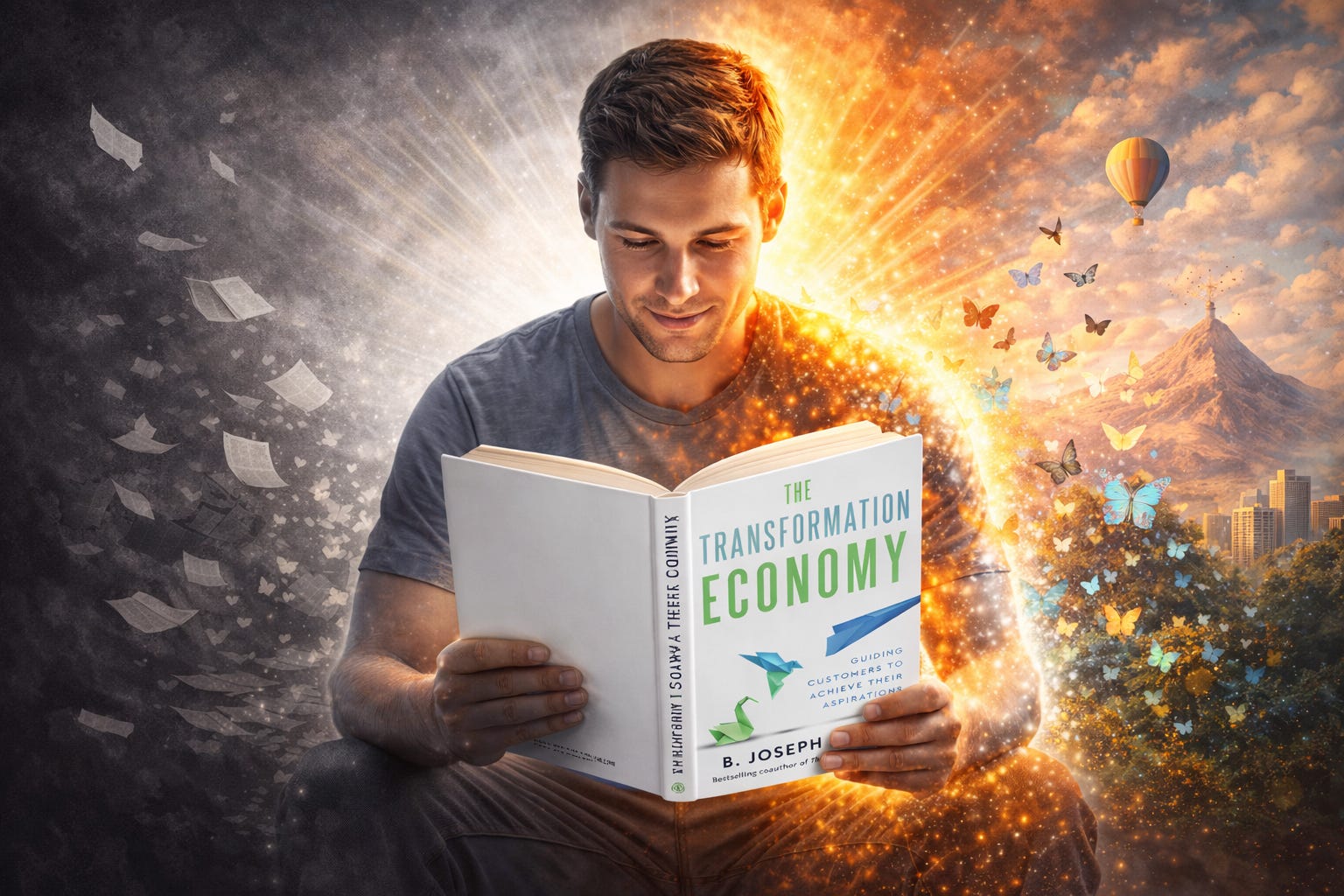
My favorite book review thus far is by Dr. Aaron Hughey, University Distinguished Professor, Department of Counseling and Student Affairs, at Western Kentucky University. Entitled “‘Transformation Economy’ inspires readers to see the world”, it was published in the Bowling Green Daily News (and if you just don’t happen to have a subscription to it you can access it here).
He quoted me extensively, highlighting some of my favorite points in the book, and concluded:
Very few books inspire me to see the world, and my role in it, in a slightly more nuanced way than I have grown accustomed to over the decades. But [t]his one falls into that category. My sense is that my experience is probably not unique. Highly recommended.
I feel like Dr. Hughey “gets me”, if you know what I mean, particularly with this paragraph:
Honestly, Pine had me on this one from literally the first few sentences. So much of what he says in this exquisite little primer on how to be more successful in todayʼs ever-evolving economic landscape rings true to my own personal quest for satisfaction and fulfillment on a deeper level. And although “The Transformation Economy” is not a self-help book, the parallels to that genre are unmistakable. In many ways, Pine is bridging the gap between those two categories by providing an intrinsic connection that is often missing in similar efforts.
Bridging that gap was exactly what I intended to do! I want people to viscerally embrace the ideas, principles, and frameworks in the book as human beings first, and then as businesspeople second. I knew it would be much easier to turn your business into a transformation guider if you recognized your own, personal, very human desire to change, to have aspirations and seek out their achievements, to become who you want to become.
I want people to viscerally embrace the book as human beings first
Personal Writing
While I was thinking along these lines who cemented the idea for me as the right thing to do was the Category Pirates – Christopher Lochhead, Eddie Yoon, and Katrina Kirsch. As I wrote in the post “Why The Future of Business Is Transforming Lives, Not Selling Stuff”, the Pirates – Arrggghhhh!!!!! – convinced me that I should write this book on Substack in the first place.
In their book Snow Leopard (which in turn is an edited compilation of their own Substack posts), they did a study about different kinds of books. The most successful were:
Personal Development books that speak directly “to” the reader. What our study revealed was that the best-selling business books of the past 20 years almost always addressed the reader directly:
· “Here’s how YOU can…”
· “Here’s why YOU should…”
· “Here’s what YOU need to know…”
The Transformation Economy, however, clearly fit in the Insights/Thinking category, the third-largest category of books in revenue. But then their research further showed:
The key here is, when writing an Insights/Thinking book, to try to make as Personal Development focused as possible. Insights/Thinking books that are interesting but not actionable rarely reach the heights of a “this book changed the way I thought about my life.”
Just like what Dr. Hughey wrote above, no?
Transformational Writing
So I focused on integrating my insights while emphasizing the personal reader to make The Transformation Economy itself, as much as possible, transformational if not a full transformation.
The book really is about you.
The book really is about you. It’s not just about what’s going on in the world of business and what you can do about it; it’s also about what’s going on in your life and what you can about that. It’s not just about how businesses can embrace the Transformation Economy and what your own business can do as a result, it’s about what you can do to achieve your own aspirations. It’s not just about how fostering human flourishing is the raison d’être of business and the reason your business exists; it’s about how you can flourish as a human being.
In prior books I would often write in the third person about customers and businesses, often writing about “ones”. After the book went into copy editing, I searched the book for an example of where I used “one” in this sense, and found only two examples (both in quotes of other people!). Then I searched the endnotes and finally found one – and only one. In Chapter 5 I wrote: “while esthetic refers to the place in which one is immersed”. I got that changed to “while esthetic refers to the place in which you are immersed”.
Yes, that makes the book easier to read, but again it’s really putting you in the book itself, and in particular in thinking about yourself as not solely a businessperson but as an aspirant, as someone who has desires to transform, as someone not simply thinking about your business and your customers but your self. (A few times I even switched between you the reader as aspirant and you the reader as guide in the same paragraph!)
As much as possible I put you in the book itself
Through this I hope that you discover personal as well as corporate aspirations (perhaps even communal or societal ones) and want to take action on them. Thinking about your self will also make it easier, I believe, to sympathize with your customers, and desire to create transformation offerings that will guide them to flourish.
Transformational Reading
Therefore, when you read/reread the book (as well as my posts on Substack) think in this dual mode, on behalf of your business and on behalf of your self. (And, yes, in all these cases I am intentionally separating “yourself” into its two constituent parts.) It doesn’t make much difference if I write transformationally unless you read transformationally. (You can lead a horse to water, . . . .)
I want your reading experience to be a transformation
And please do one more thing when you read the full book. Take advantage of its most transformational aspect, what I’ve done to encapsulate the book. Maybe you tire of hearing that word, as I seem refer to it all the time, but as I wrote just last week, if you do nothing else, encapsulation is THE Model in the book to embrace. Therefore, it’s still the most important thing you can do to turn any experience – including a reading experience! – into a transformation.
That’s why when you read the book you didn’t – or won’t, if you have yet to crack the spine or play the audio – start with a Preface and end with an Afterword, but began with a Preparation and finished with a Reflection. I wrote the opening specifically to prepare you for absorbing the ideas, principles, and frameworks and enable you to develop ideas for what you can do – personally and corporately – to embrace the Transformation Economy and thereby create greater economic value with your offerings. After introducing you to the book and showing you where it’s headed, the Preparation asks you a few questions to open your mind to the possibilities of the Transformation Economy. Ideally, you started to work on your business as you read – and maybe your self.
Then, I wrote the bookending Reflection after the last chapter specifically to help you embrace everything you’ve read and learned and apply it to your business. It also contains a series of questions – one for each chapter plus one final, overarching question – to help you determine what you should do differently as a result of reading the book, again not just corporately but personally.
Reflecting along the way along greatly increases the chance this book will have an impact on you
