

Presenting at London Experience Week
What participants learned from me

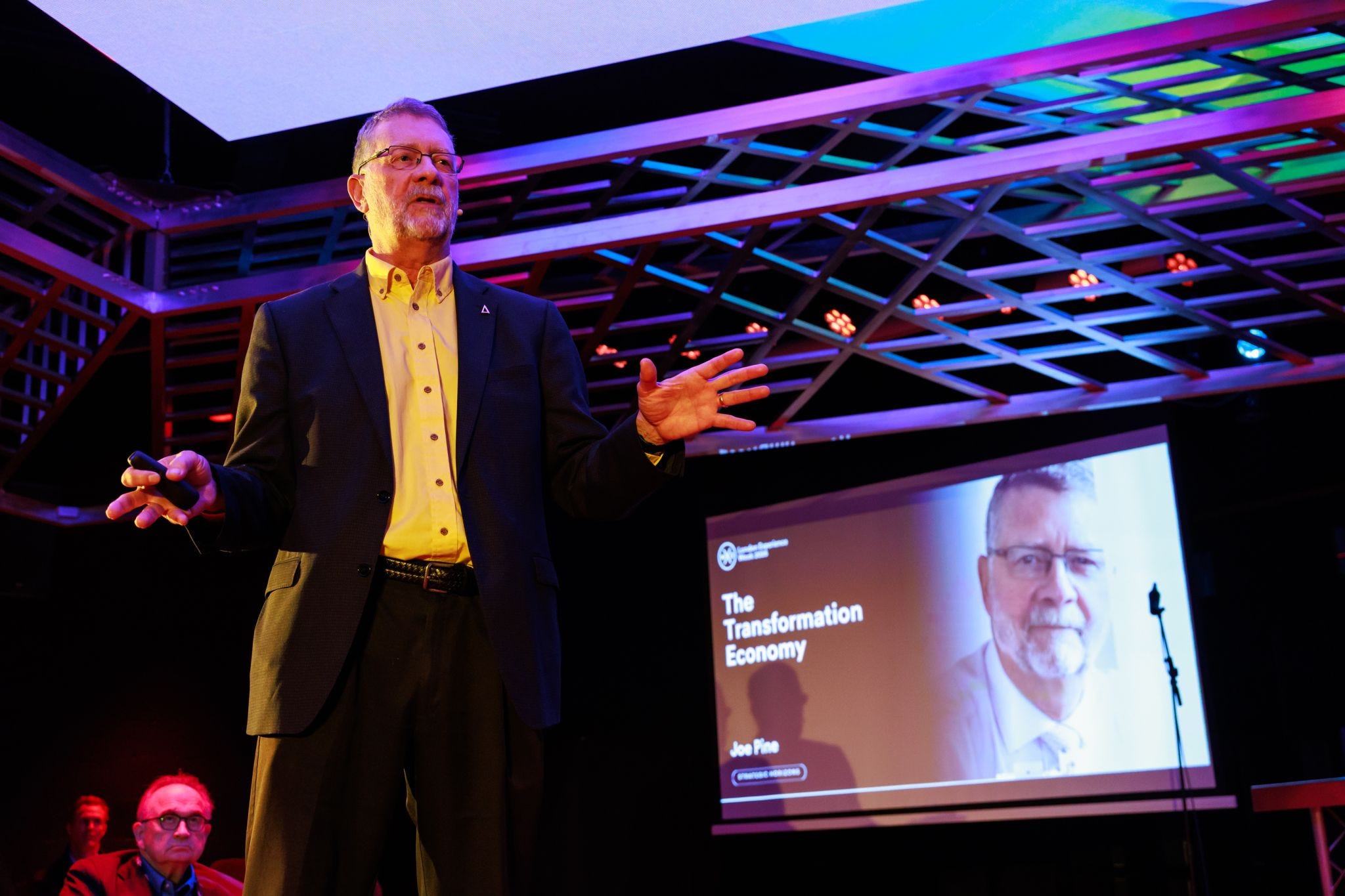
As I mentioned in last week’s post, the week of April 20 I was in the UK for London Experience Week. My primary role at LXW was being a roving ambassador and question-answerer for the Experience & Transformation Economies. (For the first time, several people asked if I was working on the next book. No, I said, please let me enjoy this one for a while!)
At LXW I was roving ambassador and question-answerer for the Experience & Transformation Economies
I also gave the opening keynote on Tuesday and conducted a workshop on Wednesday. My intention for the workshop was to give a flavor of The Transformation Toolkit by explaining the Delta Model of chapter 6 and then giving participants time to work on it. My preparation for the session was my speech, so I showed a summary slide of the Progression of Economic Value overlayed by the Time Progression (time well saved, time well spent, time well invested) from chapter 1 and asked for questions. I soon realized there were many great questions, interesting thoughts, and intriguing provocations to discuss, so I just let it go and we all had a great conversation. With a few minutes left, I finally cut the questions short to give participants the basics of the Delta Model and a handout from the tool to do as homework.
Speech: “The Transformation Economy”
But let me describe the core points of my keynote.
The tough part here is that I had already talked many times to World Experience Organization members on the Transformation Economy, including at the first and second World Experience Summits in 2023 and 2024, plus a few of the WXO Campfires. But not everyone attended those, so I wanted to hit the highlights of the Transformation Economy and weave in some new things for those that heard me before.
How to make this different than my other talks to the WXO?
I opened with a story that I hadn’t told previously, that of my friend Frances Turner and her lifelong struggle with weight (from pp. 188-9 in the book). With her permission, I related a part of her story:
Frances has long been over 300 pounds. She tried many different options to lose weight, including bariatric surgery, and several times lost 100 pounds or more – but could never keep it off.
Until, that is, she found Calibrate, a weight loss transformation that subsumes the GLP-1 Wegovy into it. With agreement from her primary care physician, the offering started with diagnosis virtually with a clinician, and proceeded through biweekly one-on-one meetings with a personal coach who worked with Frances on her personal “why” and gained a commitment from her on individual goals across a number of elements (food, sleep, emotions, exercise) to support her weight-loss aspiration.
This continued even after the weight goal was met, with Calibrate’s app offering interactions that spark enduring inspiration and commitment. Frances got down to her weight goal of 150 pounds in around a year, when the follow-through phase began. The coach, clinician, and medical team continue the focus on being healthy through this phase that Calibrate very appropriately calls “Sustaining”. To this day Frances has kept to her weight aspiration.
As you might be able to tell, I usually use that story to describe the three phases of transformation (diagnosis, encapsulated experiences, follow-through), which is what it does in chapter 7. But I think I like it as an opening example, for it has some emotional pull and gets across the idea of what transformations are all about.
Here’s a new example of transformation, and a personal one
I went from there to describe the Progression of Economic Value, which pretty much everyone knew about, with a string of examples. I ended this with at story I hadn’t thought of before, a personal one:
My wife Julie and I first went to Hilton Head Island in South Carolina 39 years ago, in 1987. I remember exactly when because she was 7 months pregnant with our first child. while I broke my ankle the week before leaving, so Julie had to carry all the luggage! Everybody knew us as the couple who walked down the beach with me on crutches as she waddled along.
The trip was a Marriot timeshare sales trip, and over a 4-day weekend we fell in love with the place! We go to Hilton Head pretty much every March for two weeks, as we were transformed into Hilton Headers, and into Marriott Vacation Club owners. Now some of you may roll your eyes at this kind of transformation, but we’ve spent over a year and a half of our lives there. It’s a real transformation, a change in identity.
Don’t roll your eyes! It’s a real transformation, a change in identity.
I used that story to segue into invitational transformations, which I mentioned in last week’s post, and which Marriott definitely staged for us.
After giving my favorite examples of this – the Johnnie Walker Princes Street experience and Eataly – I made a point specifically for this group of experience stagers, designers, and developers: ALL experiences are potentially transformative. That of course led to THE model for turning experiences into transformations, encapsulation (see p. 92ff in the book).
I now say this – ALL transformation is identity change – every time
My next point was that ALL transformation is identity change. This is the opening sentence of chapter 3, and after I said it in a presentation in January with The Transformation Architects (coincidentally also in London) one of the participants came up to me and said it was the key thing she learned from it and that I should say it every time. I didn’t up to then, but I do now!
Closing and Contending: On Human Flourishing
My last point was one that I also like to make every time: that human flourishing – via the four spheres of transformation: health & wellbeing, wealth & prosperity, knowledge & wisdom, purpose & meaning – is the raison d’être of business. I didn’t break any new ground on this in the speech, but I did when talking to several people afterward, saying that if Jim Gilmore and I had never written The Experience Economy, it would have happened anyway. After all, we didn’t invent it. We just discovered what people and companies – just like those represented here at London Experience Week – were already doing to make it happen, and developed a framework and vocabulary for people to understand and embrace it.
