

Transformations for Employers
How the ideas apply to your employer


In last week’s post, Transformations for Employees, I talked about how the concepts in the book applied not just to customers – aspirants – but to employees as well, who both largely aspire to be “more” at work and whose employers have aspirations for them to be “more” (if those employers are smart, anyway).
It was fun to hunt down, pull together, and write anew about where I discussed workers in the book, and to share articles that I had earlier written on employee experiences & transformations. Interestingly (I hope), that post was actually sparked by what I want to write about here – transformations for employers – but I felt that it would be best to first post on employees.
And this post was sparked by a speech I gave on my January swing through the UK and the Netherlands, this one for the Platform voor Klantgericht Ondernemen (PvKO), or Platform for Customer-oriented Entrepreneurship. In my pre-call with the organizers to customize my speech I found that PvKO was very focused on customer centricity, a topic I have long loved, so I entitled my speech “Creating Customer Value in a Customer-Centric World”.
Customer Centricity. . .
I can still remember the first time a client asked me to speak specifically on customer centricity. (I couldn’t remember when, but looked it up: 2006, an exec ed session at the Carlson School of Management here at the University of Minnesota.) I hadn’t ever used the term, but knew it related directly to my work on Mass Customization – efficiently serving customer uniquely. So I did what I often do in such situations: I got out the dictionary (my 20-volume physical copy of the Oxford English Dictionary being my go-to) and looked up what the words meant! You can see what I found here in the slide I used with PvKO as the “inciting incident” of my presentation:
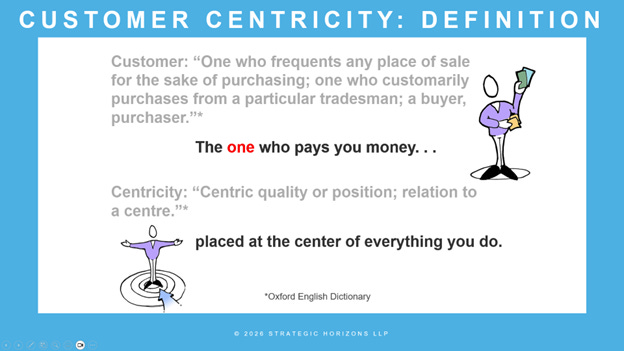
I build this slide via animations, showing first the OED definition of “customer” in black, and then graying it out to simplify is to its essence: “The one who pays you money. . .”. Then I add the definition of “centricity” in black before also graying it out to streamline it to “placed at the center of everything you do.” I then put it all together for the audience, saying:
Customer centricity means the one who pays you money placed at the center of everything you do. And the one word most important in this definition is the word “one”! The one who pays you money placed at the center of everything you do. A customer is not part of a market, nor a segment, nor a niche, nor a generation, nor a persona, nor any other agglomeration of anonymous buying units of indeterminate size. A customer is a living, breathing individual person – or, if you sell to other businesses, an active, corporeal individual enterprise. We must therefore ascend to the proposition that all customers are unique; undeniably, unremittingly, unalterably unique.
(For more on this, see the book chapter I wrote, Customering: The Next Stage in the Shift to Mass Customization. I also used the line “By definition, customers are the ones who pay you money” on p. 62 in chapter 3, “Understanding Aspirants and Aspirations”, just above my quote about learning and development departments in last week’s post. )
. . . What it Means for Employers. . .
Now, by this time you may be wondering how this slide sparked some new ideas on transformations for employers. That’s because my title here is a double entendre. I’m not writing about how employers can transform to be better employers, as you might think. No, I’m writing about how employees – including you if you work for some one or some thing else – should be guiding transformations for their employers.
You should be guiding transformations for your employer
After all, your employer is the one who pays you money!
Now, if you don’t have an employer, then it’s much more obvious that your clients are the ones who pay you money, and even if you sell lower-level economic offerings to them you should concern yourself with the why they buy from you and seek at least to be transformational, if not offer full transformations that guide them in becoming the businesses they want to become.
But the key point here is that the same is true for your employer, the one who pays you money. No matter what you offer your company today – what they have hired you to do – you should seek at least to be transformational in your work, if not focus fully on transforming your company into the business it aspires to become.
. . . and For You
So do think about why your company hired you. I’ve written about how it should never treat you as the utilitarian means to its own ends in several posts – False-Promise Offerings and Purpose & Meaning, the latter of which I quoted in last week’s post – a strong indicator that denotes how important I think Immanual Kant’s “Formula of Humanity” principle really is (although Kant adds a word to the formulation, that no one should treat others as merely means, which I tend to leave out).
At the same time, then, you should not treat your employment as merely the means for your ends of having money. That not only shortchanges your employer but takes the meaning and dignity out of your work. (By the way, “means” and “meaning” are etymologically distinct words.)
Never treat your employment as merely the means for your ends of having money.
