

The Time Tax
The Cost of Time Wasted


The Wall Street Journal publishes a book review every day, and they are almost always worth reading. Last Monday’s review of The Time Tax: How the Government Wastes Our Time―and How to Fix It by Annie Lowrey of The Atlantic was no exception.
According to reviewer Judge Glock, Lowrey “chronicles the growing burdens of government paperwork” and “argues that a vastly expanded and more generous federal government could reduce both inequality and the paperwork burden.” He then adds wryly, and correctly: “That seems unlikely.”
While Lowrey focuses her book on all the paperwork – and in particular the time it takes to fill out that paperwork – required to gain access to government benefits, Glock adds a paragraph on the totality of the issue:
The scale of government paperwork is nearly impossible to convey and even harder to believe. The government estimates, and most likely underestimates, that Americans spend about 12 billion hours a year on federal paperwork. That’s the equivalent of almost 6 million full-time employees working year-round filling out forms. If the time spent was paid at prevailing wages, the paperwork would cost $430 billion a year. And that’s just federal paperwork: These costs don’t include state and local forms.
The reviewer further notes that “nearly 60% of the federal ‘time tax’ is from actual taxes”, which the book states “demands an immense amount of citizens’ time: 7 billion hours”.
The federal time tax demands an immense amount of citizens’ time!
And all that doesn’t count the burden of state taxes, nor the burden across approximately 200 countries in the world.
It’s About Time
I love the term time tax but hate the consequences of it. In fact, I view such time wasted as a literal crime against humanity. As I write on p. 13 of The Transformation Economy,
One reality underlying the Progression of Economic Value: the most precious resource on the planet is the time of individual human beings.
Just think of the opportunity costs of the hundreds of billions of hours governments waste every year across the world – and perhaps it is in the trillions of hours. (One trillion hours divided by 8.3 billion people is about 120 hours per year per person in the world.)
Just think of the opportunity costs of time tax every year across the world!
Governments may easily be the worst offenders, but companies create their own considerable time taxes. As I write on p. 14:
Consider how contact centers intentionally reduce the time service representatives spend on the phone by compelling people to spend more time talking to machines. Or how retail stores staff their checkouts for the least personnel cost, not for the greatest customer demand—or offer self-checkout, commoditizing themselves by violating the basic contract of service companies: do activities for me.
That’s not the way to treat such a supremely valuable resource, a resource on which customers themselves increasingly put greater and greater value as we shifted first into the Experience Economy. After all, we have only a limited time on this earth to experience all we’d like to experience, and only 24 hours a day, seven days a week to do so. And once it’s gone, it can never be recovered. Nor invested in transformations.
Once our limited time is gone, it can never be recovered.
Nor invested in transformations.
What does anyone do with a precious resource? You first conserve it as much as possible, and then you use it wisely. That is what you must now do with your customers’ time. You must eliminate activities that waste customers’ time; save their time when they desire it; offer experiences where customer value the time they spend; and even – especially given the shift into the emerging Transformation Economy – guide customers in investing their time.
It’s Up to You
I encourage you to examine your own business, particularly your direct interactions with customers of whatever kind, and seek out – seriously seek out – all the ways you waste customers’ time. If you pardon my strong language (as I do feel strongly about this), you may not be able to eliminate all the time tax you foist on the world, but you can go a very long ways in diminishing it.
Seek to eliminate the time tax you foist on the world
What you should then do is change all that wasted time into either time well saved or time well spent. That is, directly eliminate the time wasted or make the use of that time into an experience. And from that base you can then work to layer on time well invested transformative experience by transformative experience.
This is a time progression that layers across the Progression of Economic Value as shown in Figure 1-2 on p. 14 of the book, but that doesn’t tell the complete story, for that visual doesn’t include time wasted. Think of it this way as its own framework:
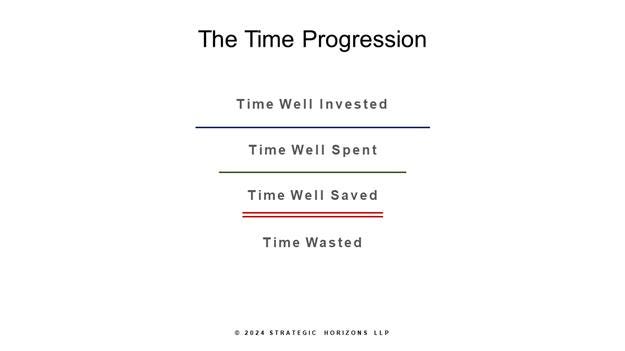
I talk about this in a little over three pages in the book, and I encourage to read (or reread) what I wrote there. But in my original outline of the book this model encompassed an entire chapter, so to really understand the concept and apply it to your business I further encourage you to read the draft chapter, “It’s About Time”, I wrote and published here on Substack in parts one and two.
This will give you many more ideas and examples to work from to eliminate your time tax and shift up the Time Progression to create every higher levels of economic value.
Think of your opportunity costs of the time tax you create
And do think of the opportunity costs of your time tax – not just for your customers but for your enterprise, for there is so much more value to be created with that time.
Joe
© 2026 B. Joseph Pine II