

The Economic Value of Experiences & Transformations
Examining some data that show it

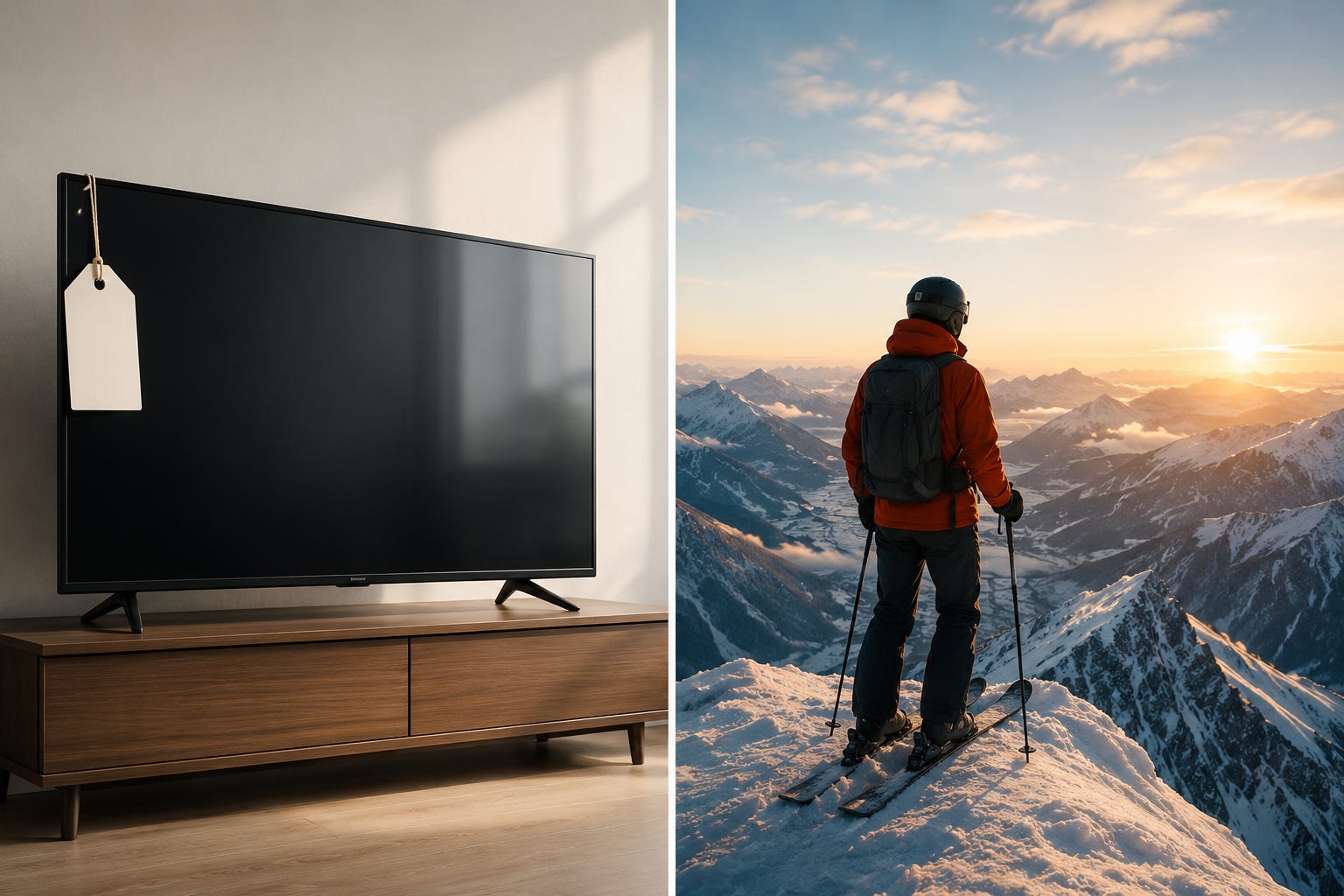
I came across a recent article by Stuart Winchester, the founder, editor & host of The Storm Skiing Journal & Podcast, where he compared the price of a TV vs. a lift ticket at Steamboat Resort over the past four decades:
So in 40 years, the price of televisions has plummeted while the quality of the product and the content available via that medium have improved exponentially, while the price of one day of skiing has skyrocketed as the quality has improved only marginally.
Why? Because the value of the skiing experience has increased, particularly relative to things. (But not relative to other experiences who “quality” – ie, engagement, meaningfulness, transportability, and transformative potential – has increased.)
Growth in Experiences
I made much the same point in an op-ed to The Wall Street Journal a few years ago. My thesis: how most people think about inflation is well, not wrong, but incomplete. As I wrote:
Inflation tends to be understood as higher prices resulting either from increased costs—global supply-chain issues and hard-to-find workers—or from increased demand, such as pent-up purchases, as well as easy monetary policy from the Federal Reserve and blowout spending from Congress. But there’s another significant factor at play: Price increases also arise from growth in the perceived value of economic offerings.
And the value created by experiences is so much higher than that of commodities, goods, and services (transformative experiences most of all, as I will get to).
I lamented that
the Bureau of Labor Statistics has yet to catch up to this shift in the economy. The standard market basket it uses to measure the consumer-price index is still weighted too much toward goods and traditional services. The result: The CPI for decades has been measured as lower than the actual rate. Shouldn’t we be more precise in measuring how people actually spend money?
I then showed this trend not with ski lift prices but with an icon of the Experience Economy: Walt Disney World. I gathered data, also over 40 years, from AllEars.net, a website dedicated to covering The Walt Disney Company, as its cheeky name implies. And then ran the numbers beginning in 1981, the year Walt Disney World no longer required separate tickets for individual rides, where (if you can imagine it) the admission fee was $9.50 ($8.89 excluding the 4% sales tax). Fast forward to 2021, and a one-day standard ticket price was $109 before taxes. Comparing these changes in pricing against the Consumer Price Index over the same period, I concluded:
That’s a compound growth rate of 6.39%. Meanwhile, the CPI increased by 2.76% a year over that same period. So for 40 years the price to go to Walt Disney World has gone up 2.3 times as fast as the CPI. Is that because its costs—cast-member wages, ride-building supplies—have gone up so much more than in other businesses? Hardly. It’s because of more engaging and immersive rides, greatly expanded areas, shorter wait times and more personal attention.
That’s why Walt Disney World outpaced measured inflation by so great a rate—because consumers value its experience more than the average market-basket good and are willing to pay much more for it relative to other offerings. This same effect is true for the myriad experiences that make up today’s “Experience Economy.” [Those quote marks were added by the WSJ editor, much to my chagrin.]
And since COVID prices to Disney theme parks have increased even more! Time well spent is simply worth more to people than time well saved.
Growth in Transformations
People value time well invested beyond even that.
The fifth and final economic offering – transformations, built atop experiences – have increased even more than experiences over the past few decades. Expenditures on healthcare, for example, have grown astronomically around the world (albeit at a higher rate in the US) for at least five decades, far outpacing increases in the Consumer Price Index (CPI) and Gross Domestic Product (GDP) across the rest of the economy. In the same way, US college tuition has grown around three times the rate of inflation over the past five decades.
People value time well invested over time well spent and time well saved
As I wrote in the chapter 1 box “The Economic Value of Time” in The Transformation Economy (p. 18):
Yes, in higher education and health care such factors have increased costs—most notably the increase in the ratio of administrators to instructors in education and the growth of technology in health care. [I should have added also that another big factor is government intervention in both these transformation sectors.] But primarily it’s valueflation, an increase in price because of the higher value customers place on transformations (and to a lesser degree experiences), relative to the lower-level offerings in the Progression of Economic Value.
Valueflation: an increase in price because of higher value, not higher costs
There isn’t as good a premier exemplar of transformations (yet!) as The Walt Disney Company represents for experiences, but in The Experience Economy Jim Gilmore and I offered statistics on the five economic offerings – with the yeoman’s work on the data here done by Lee Kaplan of Lee3 Consultants LLC. It involved looking at some proxies as well as some guestimation as to what counted as experiences and transformations since, again, governments do not (yet!) track these separately from services, but here are the results for the fifty years from 1959 to 2009 (when we last updated it):
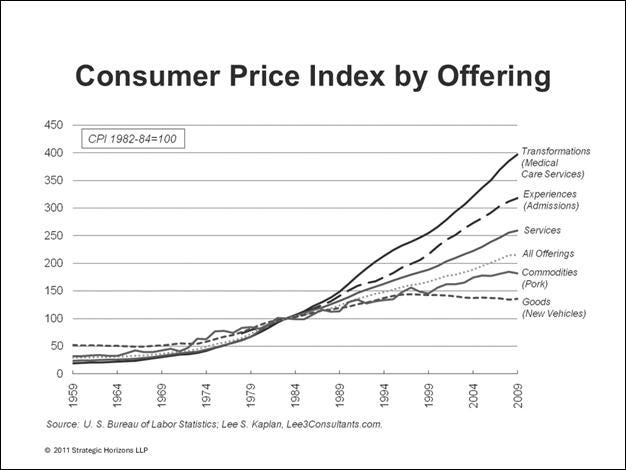
There’s the valueflation of experiences & transformations!
I’ll also throw in the other data we collected on the growth in employment and gross domestic product across the five economic offerings:
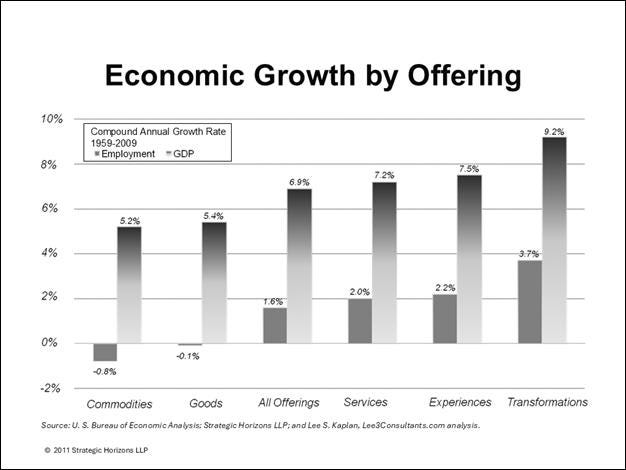
As you can see, transformations have grown far more in both employment and GDP than the other economic offerings.
We included the same data (through 1997) in the original edition of The Experience Economy in 1999 and updated it to what you see here with the Updated Edition in 2011, but did not update it for the re-release in 2020. Why? Frankly, I never have to make the case via economic statistics anymore! I used to have to argue with people that the economy was shifting from services to experiences and experiences to transformations, but now I just have to say and explain it, and everybody gets it.
I never have to make the case via economic statistics anymore!
Nonetheless, Dave Norton, founder of consumer insights consultancy Stone Mantel, did further work as part of the transformation track of The Collaboratives to look at the size the Transformation Economy (with the data work again being done by Lee Kaplan). Take a look at The Transformation Economy Is $3.6 Trillion, and You Need to Pay Attention: A Stone Mantel Summary Report to delve into this more deeply.
For it doesn’t hurt to understand the value of transformations in this way. They reside at the top of the Progression of Economic Value for a reason. There is no more economic value you can create than to help people achieve their aspirations, become who they want to be, and flourish.
Joe
© 2026 B. Joseph Pine II
The “valueflation” concept is incredibly useful here, especially for sectors like hospitality, wellness, and travel.
So much of the industry still tries to justify pricing through tangible inputs: square footage, amenities, labor, F&B, programming costs. But the guest is often valuing something much less tangible: renewal, identity, meaning, connection, confidence, recovery, clarity.
That feels like the real shift from experience to transformation. The economic value is not just in what happened during the stay, but in what the guest believes becomes possible afterward.
You nailed it with this essay, Joe. As an aside, I am probabaly that rare person the subscribes to both you and Stuart Winchester.
The “annual buddy ski trip” is a great example of transformation-the mix of sking, hospitality and social connection. The social connection in my mind is a big part of the transformation economy. In the concert business, festivals are thriving because of this, the shared experience that is part of the offering, not solely the concert itself.