

Outcomes-based Pricing in B2B Situations
And why it’s the way to go

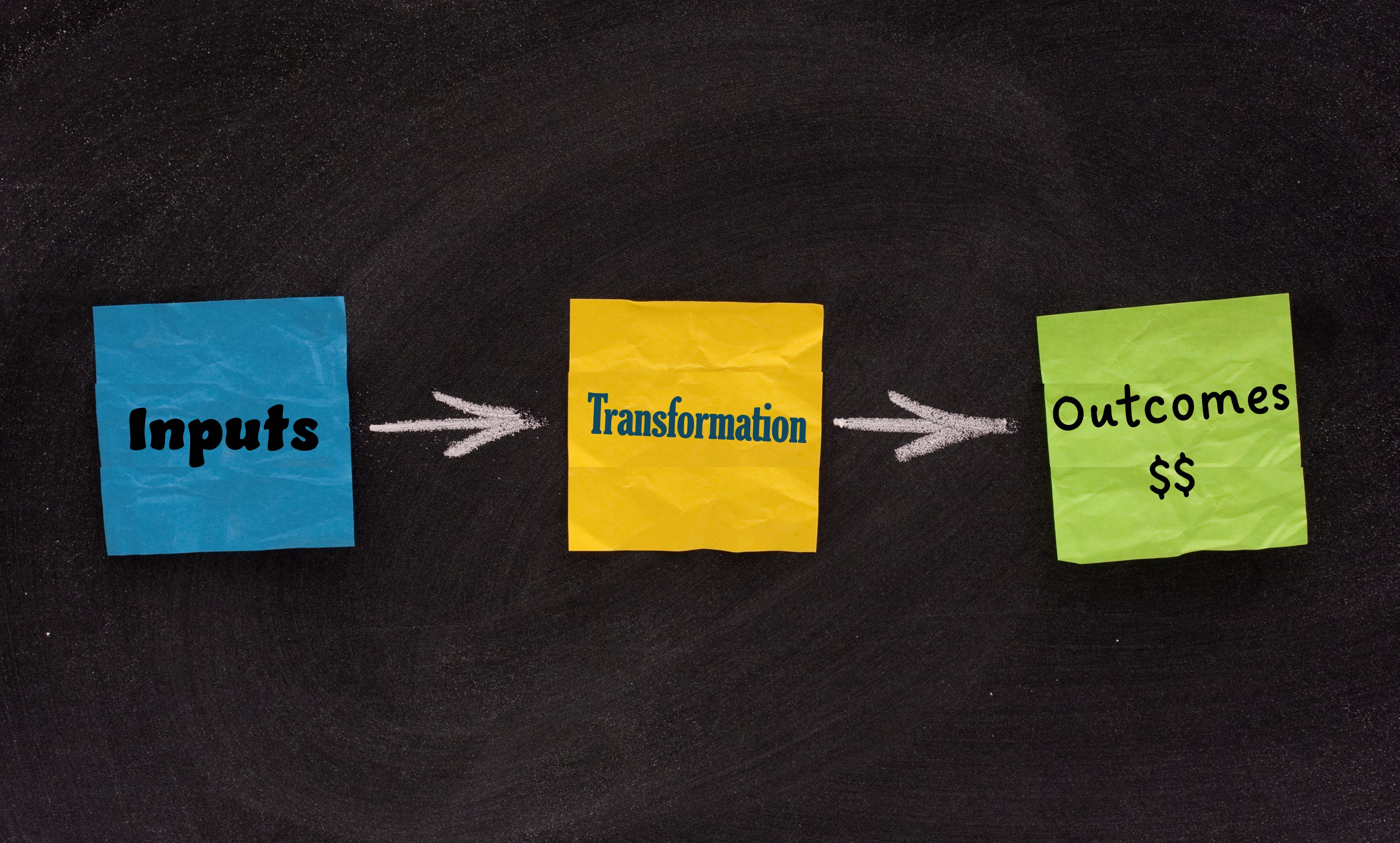
One of my favorite statements of all time (even if it does end with a preposition) is “You Are What You Charge For”. I’ve said it countless times in my work with clients. Jim Gilmore and I used it three times in The Experience Economy. And it turns out I wrote it four times in The Transformation Economy. (Both those count section headers.)
You Are What You Charge For!
Charge for Outcomes
What that statement means for the Transformation Economy is that you should charge for the demonstrated outcomes your customers achieve, as I wrote about in this post. I think that is particularly important in B2B situations, for no business customer ever buys your offering because they want your offering; it’s always a means to an end. If you sell the end – and especially charge for that outcome – then you will create much more economic value.
However, today most companies putatively in the transformation business (whether their offerings are for consumers or businesses) charge for inputs, not outcomes.
However, most transformation guiders still charge for inputs, not outcomes
That includes consulting companies, perhaps the most down-the-plate B2B transformation business around. But a recent article in Business Insider speaks to how that is changing, specifically because of AI projects where the results are still so dicey. Companies worry that it won’t provide real value, as with so many other huge shifts in the past. Remember business process reengineering? Probably not.
But you may remember the oft-quoted statistic from a recent MIT study that 95% of AI projects fail:
Despite $30–40 billion in enterprise investment into GenAI, this report uncovers a surprising result in that 95% of organizations are getting zero return. The outcomes are so starkly divided across both buyers (enterprises, mid-market, SMBs) and builders (startups, vendors, consultancies) that we call it the GenAI Divide. Just 5% of integrated AI pilots are extracting millions in value, while the vast majority remain stuck with no measurable P&L impact.
Impact is precisely what clients are looking for – however they individual define and determine that outcome they desire – but is so often left unachieved.
That’s why they increasingly insist that consulting companies put their money where their mouth is – and base their incomes on those clients’ outcomes. As journalist Polly Thompson opens that BI article, “AI is reshaping how McKinsey makes money“ (emphasis added):
AI is changing the nature of consulting work and the way firms charge for their services.
Consulting giant McKinsey said that a quarter of its fees are now driven by outcomes-based pricing.
Clients are increasingly looking for support on complex, multi-year projects, the consultancy said.
McKinsey & Company says AI is reshaping what it offers clients and how it charges them. “We’re doing more performance-based arrangements with our clients,” Michael Birshan, managing partner of the UK, Ireland, and Israel at McKinsey, told reporters at a media event in London earlier in November.
Consultants have traditionally billed clients based on a project’s scope and duration, with a portion of their fees tied to the number of billable hours worked by the team. Now, rather than saying, “Here’s a scope, what’s the fee for that?” clients are coming to McKinsey and saying, “Here’s the outcome we’d like to get to,” and the fee will be mostly contingent on the performance McKinsey can deliver, Birshan said.
Note that this change is client-led, when all consulting companies should be leading the charge into charging for outcomes (pun intended).
. . . But Not Necessarily Just for Outcomes
That doesn’t mean consulting companies – nor your company, B2B or otherwise – need to put everything on the line. It’s ok to charge for your offerings partially on a service basis – as Thompson writes immediately after the above excerpt, “Some fixed cost components remain”. You can even charge partially on an experience basis (particularly via membership fees in situations with an ongoing relationship such as in consulting), with the remaining portion paid on a transformation basis.
That doesn’t mean transformation guiders need to put everything on the line.
I wrote about doing so in “Charging for Change”, which highlights four different ways that transformation guiders can charge for the demonstrated outcomes customers achieve. And particularly for those in so-called “professional services” businesses (including not only consulting but accounting, legal, architecture, and so forth) I highly recommend the book Times Up! The Subscription Business Model for Professional Firms, by Paul Dunn and Ron Baker, which I reviewed here.
The Benefits of Outcomes-based Pricing
What I’ve long said about why experience stagers should charge for the time customers spend with them – that it sends a signal that this is a place worth experiencing – has its analogue with charging for outcomes: it sends a signal that you are in the transformation business.
Align what you charge for with what your customers value
Second, it means you align what you charge for with what your customers value: the outcomes they desire in achieving their aspirations. Over time, every business needs to make this alignment happen or you will not create the value customers desire, and your business will suffer commensurately, particularly as competitors themselves ascend to the proposition of outcomes-based pricing.
Outcomes-based pricing is a catalytic mechanism ensuring that you do everything it takes
Third, such pricing is a catalytic mechanism ensuring that you do everything you can to guide your customers – your aspirants – to achieve their aspirations and thereby recoup your costs and make a profit. When you make your income dependent on your aspirants’ outcomes the chances you really do all that may be required to transform them go up.
Charging for outcomes is the most profitable way to guide transformations
Fourth, especially if this catalyzes the effectiveness with which you guide transformations, charging for outcomes will yield the greatest profitability by far. Profits should not be your end goal, of course, but they are the measure of how well you guide your aspirants in meeting their end goals, in achieving their aspirations. The better you do that, the higher the profits.
And charging for outcomes builds trust
Finally, here’s something I never thought about until reading this article on how McKinsey and other consulting companies are more and more charging for outcomes: it builds trust, trust that enhances the relationship between guide and aspirant and increases further increases the chance of transformation success. As Reid Litman, the person whose comment on Business Insider’s LinkedIn post alerted me to the article, told me, “Outcome-based pricing, AKA transformation in the business context, isn’t just a financial model, it’s a trust signal. It says: we believe in our ability to change your business so much, we’ll only get paid if we succeed.”
Always remember: it’s about outcomes, not inputs.
Joe
© 2025 B. Joseph Pine II