

My Lady Nicotine
A case study in how to use the Varieties of Visitors framework

Sorry, I lied! I decided to do a follow-on to last week’s post, which was supposedly the final one arising from London Experience Week, particularly since I’ve received some nice feedback from people that found last week’s post on Varieties of Visitors of benefit.
So one of the things the World Experience Organization sets up as part of its summit week every year is an “experience safari” where participants can experience some of the best or newest or most intriguing or outré experiences in London. I went to a few of these, although many people took advantage of the opportunity to experience eight, ten, or more. (Most of them are much younger with far more energy and less need of sleep than I have!)
A Gallery Experience
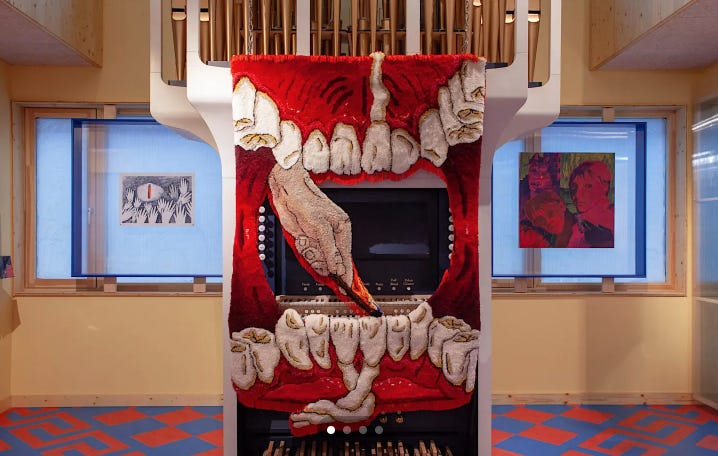
One of the experiences I went to: My Lady Nicotine, “An exhibition exploring nicotine as ritual, vice and cultural symbol through contemporary art and historical objects” as the show’s rundown puts it.
Not having read that first, I didn’t go into the experience with any expectations other than it being from the creative and somewhat subversive minds of Sam Bompas and Harry Parr, founders of (naturally) Bompas & Parr, “a creative studio made up of artists, architects, chefs, designers, marketeers, strategists and technologists”. With an emphasis on the creative, for I can’t think of anyone who better exemplifies that word in experiences. Do click on that link above and scroll through the seemingly never-ending amazing projects they’ve done! (And notice how much of their work involves food and drinks, hence the need for chefs on the payroll.)
It’s an experience from the creative and somewhat subversive minds of Sam Bompas and Harry Parr
I’ve met Sam personally – I once saw him get thrown out of an event (not by the organizers, but by the event space) for, shall I say, the overexuberant use of pyrotechnics – and the best part of this experience safari event at the company’s own gallery was the surprise appearance of Sam himself, who talked us through the exhibition and then took us on a tour of the studio, including the basement area with artifacts of past and future experiences. My fellow participants and I also got to pick his brain on all they do.
As for the experience for which we came, it was the opening exhibition for the new gallery space, called Woodward Henry, in a portion of the main floor of the studio and primarily by Harry Parr. As the exhibition’s webpage describes it:
Taking its title from J. M. Barrie’s 1890 book My Lady Nicotine, the exhibition frames nicotine not simply as a substance but as a powerful cultural symbol. Barrie famously personified tobacco as a seductive companion to writers and thinkers, and the exhibition extends this idea into the present day, examining why nicotine imagery continues to appear across contemporary culture, from art and fashion to nightlife and online communities.
The show is “pretty unequivocally critical of smoking” but also “curious about the future creative possibilities of nicotine”
Do take a look at that website link to get a flavor for what is there. As you will see, the show is, as Sam put it to me, “pretty unequivocally critical of smoking – half of the 1.2bn smokers on the planet will be killed by the habit”, but is also “curious about the future creative possibilities of nicotine” (as Bompas & Parr always exude creativeness). He elaborated:
The more recent science indicates [there] are many benefits although it is also unbelievably addictive. Novel delivery mediums can potentially allow for pleasure whilst minimising risk. So there’s scope for innovation. At the same time it is good to give space and understanding to the history, ritual and culture.
Ultimately, as with all our work, bodily pleasure is important and legitimate.
With the studio’s ethos being drawn from Blake. “The road of excess leads to the palace of wisdom.”
Analyzing an Experience through the New Lens
Now let’s analyze My Lady Nicotine through the lens of the new 2x2, Varieties of Visitors, which I’ll put here for ease of reference:
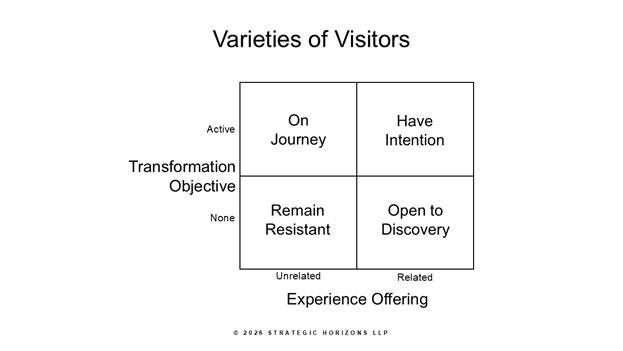
It seems to me a beautiful way of looking at the individuals coming to see the exhibition.
Some visitors are smokers and have an intention of quitting the habit
First, some visitors are smokers and have an intention of quitting the habit. They may even have come to seek help from My Lady Nicotine to help push them along in that intention. Or maybe for some smokers there’s some hesitation, some less-than-certainty, and they seek to firm up their commitment to quit. Either way, there’s plenty to see that portrays smoking as vice, including art objects that display many negative effects of the habit, books with all the statistics, and numerous stories that put cigarette smoking in a negative light (pun intended).
Some people, also smokers, are already on a journey to, say, be more fit
Second, some people, also smokers, are already on a journey to, say, be more fit. Many smokers know that quitting smoking often causes people to gain weight, and so haven’t taken the step. Here they may find enough negativity to make that step, and recommit to greater work in fitness elsewhere to make up for any weight gain that may arise. (Even non-smokers on a fitness journey may get some psychic benefit of thinking themselves “not like those smokers”.)
There may be other smokers who are perfectly fine with smoking
Third, there may be other smokers who are perfectly fine with smoking, who may discover here enough to get them to reconsider the habit. They may enjoy the ritual, the sub-culture of smokers who meet outside of offices and bars to partake in a communal activity, and may ignore the negative aspects as something whose effects, if any (not all smokers get lung cancer, and not all those with lung cancer smoke), are far down the road. Out of sight, out of mind, but My Lady Nicotine may bring it front of mind and thereby create the impetus to at least think about the consequences, and perhaps even make the commitment to quit.
