

Learning from Healthcare
What medicine teaches about creating real transformation

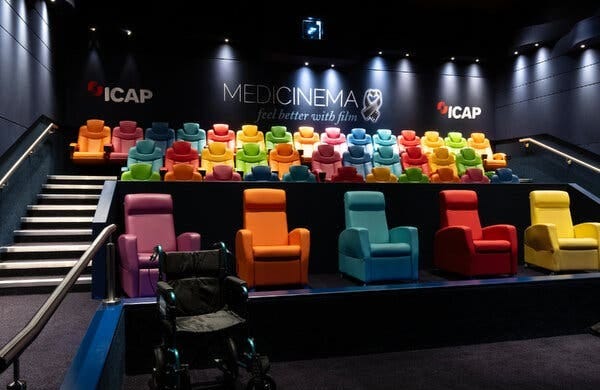
I was struck by an article in The New York Times this week entitled “Five Stars for Cinematic Care”. (At least in the paper edition; online it’s entitled “Health Screenings: Where Hospitals’ T.L.C. Includes a Movie Theater” for whatever SEO/clickbait reasons.)
It highlights the UK-based non-profit MediCinema that, as the name applies, bring movies into hospitals. Its tagline is “feel better with film” and its website says, “We provide cinema experiences inside hospitals to support the emotional, physical and mental health of NHS patients.”
MediCinema helps patients “feel better with film”
The organization intrigued me as it is certainly transformational, if not a full transformation. The article relates many stories of patients who were uplifted by being able to see movies in (sound-proofed) rooms in UK hospitals – and where need be in their own rooms – including one where it converted a “medical lecture theater” to outfit it with “a full-size cinema screen, a projector and tiered seating”.
Here’s a description of one such showing:
The dozen patients in the audience included a woman waiting to give birth, a 4-year-old with an autoimmune condition and a 71-year-old with a bone condition whose youngest son had come to watch the movie with her. It was one of four regular screenings that week in the 40-seat movie theater, which also has space for four bedridden patients and three patients who need recliners.
And the movie shown was Toy Story 5, which opened less than a month ago! Whereas distributors used to make MediCinema wait for new releases, now they “often give the nonprofit preview copies, allowing patients to see the films before they appear in multiplexes.” And some patients take advantage of such bragging rights.
The Benefits
Why does MediCinema do this? Founder Christine Hill wanted patients to be able to experience the same joy she gained from seeing movies. (She was awarded the Member of the Order of the British Empire, or MBE, from Queen Elizabeth for her work here!)
But it’s about so much more than joy. It’s about greater outcomes for patients, as journalist Alex Marshall writes:
At a time when doctors and academics are increasingly recommending that people visit museums, theaters and concert halls to improve their health, MediCinema is one of several organizations making sure hospital patients don’t miss out on the benefits of culture either.
There is a growing realization that “patient experience influences patient outcomes,” said Daisy Fancourt, a professor at University College London who has written extensively on the links between culture and health. Too often, she said, the benefits of the arts in clinical settings have been undervalued.
Nurses at the recent “Toy Story 5” screening did not need convincing. “Sometimes when you’re in hospital, patients lose their sense of identity,” Nikki Mulhall, one of the nurses on duty, said. “But when they come here they can be themselves.”
The link above to Dr. Fancourt’s book, Art Cure: The Science of How the Arts Transform Our Health (which came out the same month this year as The Transformation Economy!), reminded me of Susan Magsamen and Ivy Ross’ book Your Brain on Art: How the Arts Transform Us, which I reviewed here on my Substack last year. I highly recommend both, even if I haven’t yet read Art Cure. But here’s how Amazon describes it:
From cradle to grave, engaging in the arts has remarkable effects on our health and well-being. Music supports the architectural development of children’s brains. Artistic hobbies help our brains to stay resilient against dementia. Dance and magic tricks build new neural pathways for people with brain injuries. Arts and music act just like drugs to decrease depression, stress, and pain, reducing our dependence on medication. Going to live music events, museums, exhibitions, and the theater decreases our risk of future loneliness and frailty. Engaging in the arts improves the functioning of every major organ system in the body, even helping us to live longer.
This isn’t sensationalism, it’s science: the results of decades of studies gathering data from neuroimaging, molecular biomarkers, wearable sensors, cognitive assessments, and electronic health records. From professor Daisy Fancourt, an award-winning scientist and science communicator and director of the World Health Organization’s Collaborating Centre for Arts and Health, this book will fundamentally change the way you value and engage with the arts in your daily life and give you the tools to optimize how, when, and what arts you engage in to achieve your health goals. The arts are not a luxury in our lives. They are essential.
Focusing on Outcomes
Dr. Fancourt is exactly right when she says “patient experience influences patient outcomes”. The reason I have worked so much with healthcare companies, hospitals in particular, over the past few decades is that research shows that the better the patient experience, the better the outcomes. And of course health & wellbeing outcomes are what healthcare is all about.
“patient experience influences patient outcomes”. Exactly.
I keep a collection of academic articles that show this in case needed with clients. I can still remember the very first one, coming out in September 1994 just months after I discovered that experiences & transformations were distinct economic offerings. It was “Acting in Medical Practice” in the British medical journal Lancet where Drs. Hillel M. Finestone and David B. Conter asserted that physicians must be trained as actors:
If a physician does not possess the necessary skills to assess a patient’s emotional needs and to display clear and effective responses to these needs the job is not done. Consequently, we believe that medical training should include an acting curriculum, focused on the conveying of appropriate, beneficial responses to those emotional needs.
In my practice . . . I frequently treat individuals who are in chronic pain. I find it essential to convey an encouraging, hopeful, often cajoling message to the patient to communicate concern and, more importantly, the need for the patient to work on self-improvement.
Back then, many physicians disagreed with, disparaged, or ridiculed the notion of doctors becoming actors. I in fact discovered the journal piece because of an article in the local paper, “Doctors Can Act as If All the World’s a Stage,” where one humorous physician wrote that with drama “an official part of medical school curriculum” we would see scenes like this one: “Problem: Obesity. Old way: Doctor gives printed diet sheet. New way: Music swells as doctor stands in front of brilliant sunset, tears welling up, and makes the emotional, heart-rending promise, ‘As God is my witness, you will always be hungry again.’”
Giving patients a printed diet sheet is woefully inadequate
Now, many physicians understand that acting on the medical stage is indeed crucial, and hopefully all understand that giving patients a printed diet sheet is woefully inadequate. (See the example of Calibrate and how it incorporates GLP-1s into a complete transformation offering, including charging for outcomes, on pp. 188-190 and 195-6 of The Transformation Economy.)
Perhaps the best resource for understanding how outcomes depend on experiences in healthcare is the book Compassionomics: The Revolutionary Scientific Evidence that Caring Makes a Difference by medical doctors Stephen Trzeciak and Anthony Mazzarelli. While couched in the terms of compassion – and “Compassion is a vital driver of patient experience” (p. 225) – the tremendous amount of research amassed here indeed shows how better, more engaging, more compassionate patient experiences yield far better outcomes.
And the sad truth is that many doctors and, I believe, most all nurses go into healthcare because of their compassion, which then gets beaten out of them in so many hospital systems. Compassionomics is a cri de coeur to counteract this and keep it from happening.
Learning from Healthcare
The fact that effectual transformations depend on memorable experiences applies not only to healthcare providers but to every transformation guider in all four spheres of transformation.
Effectual transformations depend on memorable experiences!
So in your business, for your transformation offerings, be sure to focus on the experiences you stage that yield the transformations your customers seek to become who they want to be and thereby flourish.
And, where appropriate, stage them with compassion.
Joe
© 2026 B. Joseph Pine II
If hospitality wants to get serious about transformation, we should borrow from the one industry that's been forced to think about outcomes. Great framing.